Chapter-2: Motivation and Fun
Outline of Article:
- The Third Interconnected Question of Consciousness
- The Fourth Interconnected Question of Consciousness
- Thank You
The Third Interconnected Question of Consciousness:
Why does motivation fluctuate in the presence of others?
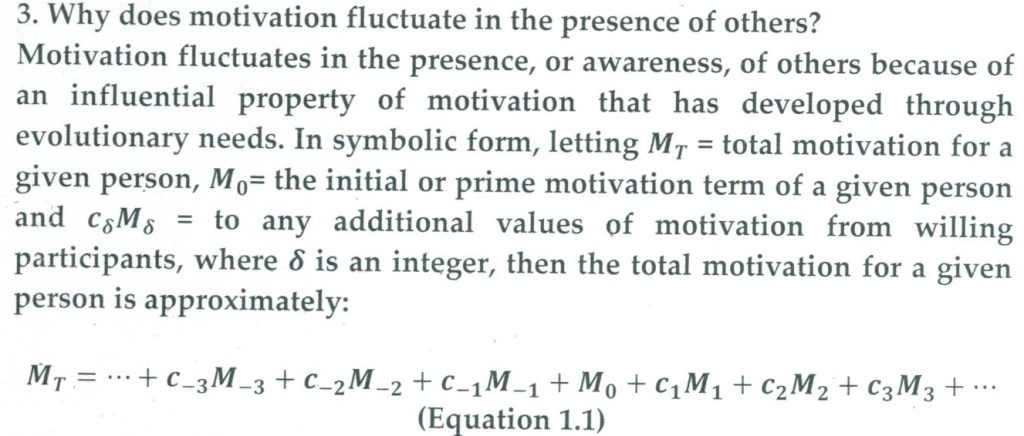
To be clear, a person’s total motivation is 100% determined by their free-will of choice. However, it would be foolish to deny that outside influences have no bearing on choice of total motivation. In other words, depending on a person’s surroundings, a person’s motivation may change from one state to another, high to low or low to high—almost as if by some contagious influence. Still, these fluctuations are very much dependent on a person’s free-will of choice to accept.
Upon closer inspection, what is actually happening when a person is invigorated by the presence of a highly charismatic individual? And, in an opposite manner, what is happening when a person is drained of motivation by the presence of a monotone, indecisive, high maintenance or negatively biased person?
One interpretation that accounts for these fluctuations in motivation is that, each individual person is able to contribute a certain percentage of their motivation to others—in a positive or in a negative form. However, the receiving of these percentages is not forced upon others—acceptance is still free-will dependent.
Another curious aspect of motivation is that proximity or current existence of others does not seem to be a strict requirement. Meaning that, in certain cases only some level of residual awareness is needed in order for a person to gather additional percentage terms of motivation from others.
However, in general, close proximity and frequency of proximity with others will have a much greater, and immediate, impact on a person’s total motivation. This is more apparent in early life span development; and, may be less dominant with greater maturity in life.
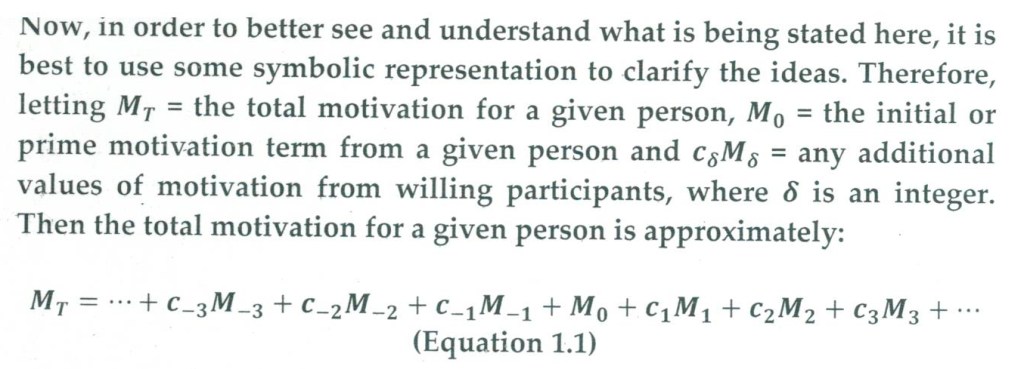
There are four comments that need to be stated with respect to equation-1.1. First, there will always be at least two infinite source sum-directions of motivation for any given person. These two sources will automatically be drawn from the biological father and biological mother of a given person. From an evolutionary perspective, this influential property of motivation—of giving and receiving additional motivational terms—serves as a critical source of supplemental motivation for early life span development.
Caution, dear reader, equation-1.1 suggests that for maximal life span development, both biological parents are needed, especially in early life span development. However, later in life, it may be possible that additional infinite branch summation directions may appear, in conjunction with the original two branch paths of sums. Or, that a reordering of sums from both directions may develop or branch off. At any rate, there are at least two sources of motivation, for any given person, starting from the instantaneous moment of conception.
The second comment is with the additional terms to the left and to the right of the initial main source term of motivation, M sub zero. From the perspective of evolution, it stands to reason that any additional terms will first try to come from immediate family members of biological mother and father; and then any additional motivation terms will come from friends, associates and then everything else that is alive or within the reality of a given person. That is to say that, to a certain extent, there is some percentage of influence from all life in the world, and from all life in the universe.
The third comment deals with the “C” values in front of the additional motivation terms “M”. These “C” values indicate percentage of influence and quality of motivation: ether positive or negative. However, these “C” values are not automatic. There is still a dependence on a person’s free-will to accept any quantity of motivation.
The fourth comment that needs to be made is with the, three dots or the ellipsis, on both ends of the right hand side of equation-1.1. These symbols indicate that all human beings will be able to contribute to any and all person’s total motivation, current or past. Further still, it is also possible that after human beings have been accounted for, then all other beings in existence may contribute, to a certain extent, to the total motivation of an individual.
At this point, I am now able to provide an approximate solution to the third interconnected question of consciousness, with respect to motivation and fun.
The Fourth Interconnected Question of Consciousness:
What are the factors of fun?
One of the main reasons that motivation and fun are often confused for one another is because of the factors they share. Granted, there are numerous ways to define fun; but, I have narrowed down the overall definition of fun to a general set of factors. Specifically, the main factors of fun are: value, expectation, willpower and joy.
As can be seen, three of the main factors of fun are the exact same factors that are found within motivation. But, there is a crucial difference. The way in which the factors are used, within fun, makes a tremendous difference. As such, motivation and fun are nowhere near equivalent expressions.
Before stating the actual formula for fun, I will need to define four important terms: emotions, joy, happiness and pleasure.
Recall that within this book, consciousness is defined as consisting of at least three types or orders of consciousness. However, in addition to these three types being primarily responsible for distinct labors of awareness and connectedness with reality, they must also exist in a type of partitioned manner, with one another. As such, direct communication does not exist between the three types of consciousnesses. Instead, there are indirect processes that allow for communication to occur between the three types of consciousnesses. One such way is through emotions.
Hold for moment, dear reader, in chapter-3, I will provide some justification for the partitioned—yet, interconnected—existence of the three types of consciousness. And, why the three types of consciousness must not have direct communication between each other. Until then, for now, I will continue on with providing some basic definitions:
Emotions are one form of free-will communication between the three types of consciousness, which are the result of specific chemical releases within the body.
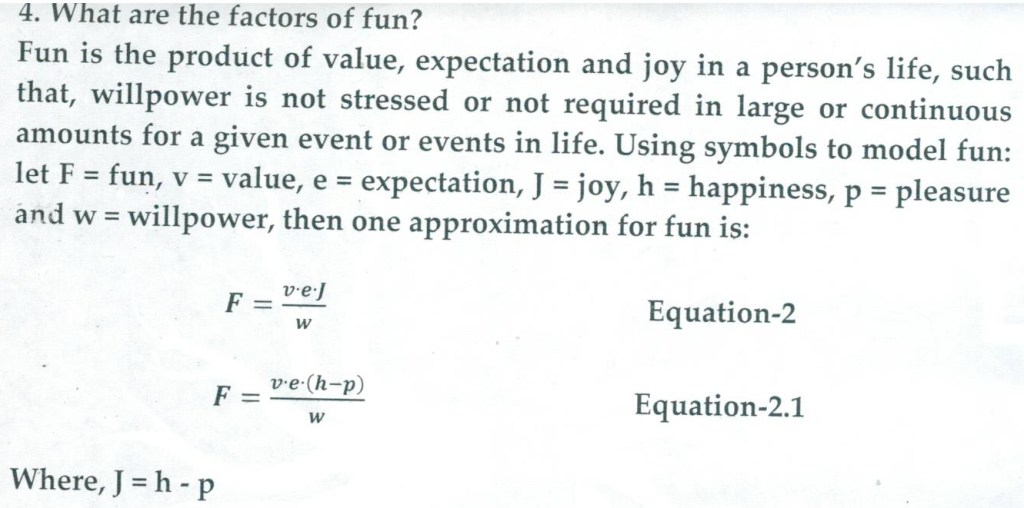
Joy is an ostensibly positive emotion experienced within the body. However, in a more precise manner, joy can be further defined as the difference between happiness and pleasure. In other words, letting J = joy, h = happiness and p = pleasure, then J = h – p. Of course, an immediate question is, why a difference? The answer is based on evolutionary developments. And, once I define what is meant by happiness and pleasure, the reader will see why this difference exists.
Happiness is a positive emotion that results from experiences, actions or thoughts in support of evolutionary positive development. In other words, happiness is based on: responsibilities for self and others; long term connection with others; positive contribution to self, to family and to community; mutual healthy communication with others; accomplishment of positive goals in life, in the pursuit of willpower development; and, not based on artificial influences, such as drugs.
Pleasure is an ostensibly positive emotion that results from experiences, actions and thoughts that are not in support of positive evolutionary development. In other words, pleasure is based on: hedonistic practices; self centered life style choices; ignoring personal, family and community responsibilities; deception of others for personal gain; manipulation of others for personal desire; and, the use of recreational drugs.
In general, fun can be defined as the product of value, expectation and joy in a person’s life, such that willpower is not stressed or not required in large or in continuous amounts for a given event or events in life. As such, fun is inversely affected by willpower.
At this point, I am now able to answer the fourth interconnected question of consciousness, with respect to motivation and fun.
Thank You
Thank you for your attention, Dear Reader. I am grateful for your time and consideration of my ideas. Next week, I will post the third part of Chapter 2 on: Motivation and Fun.
 Total Consciousness