Chapter-2: Motivation and Fun
Outline of Article:
- Fifth Interconnected Question
- Sixth Interconnected Question
- Seventh Interconnected Question
- Thank You
The Fifth Interconnected Question of Consciousness:
Why does fun fluctuate in the presence of others?
The reasoning for this question follows the same ideas as the fluctuations within motivation. Furthermore, it appears that the main factor of influence (that acts as a contagious factor) may be a person’s willpower. Meaning that, a person’s willpower may be the driving force that can cause fluctuations in another person’s total fun or total motivation. In addition, it appears that these fluctuations may also be the result of evolutionary developments, such that a contagious ability exists within every human being, within their individual fun and motivation.
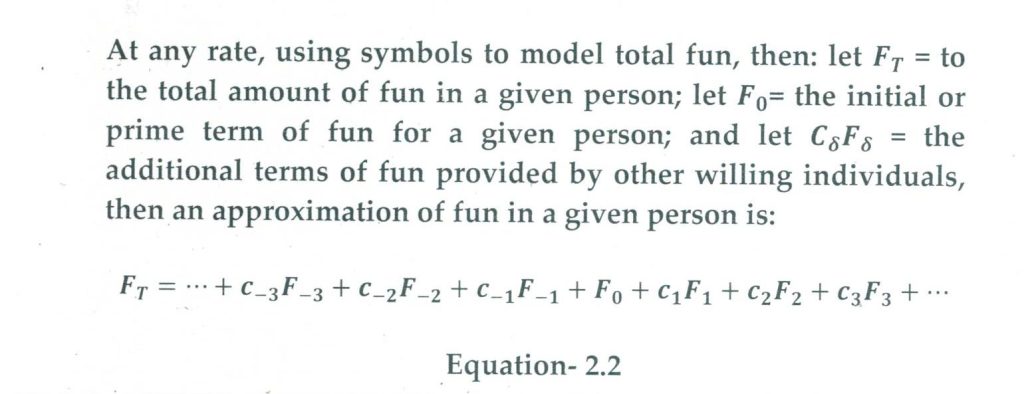
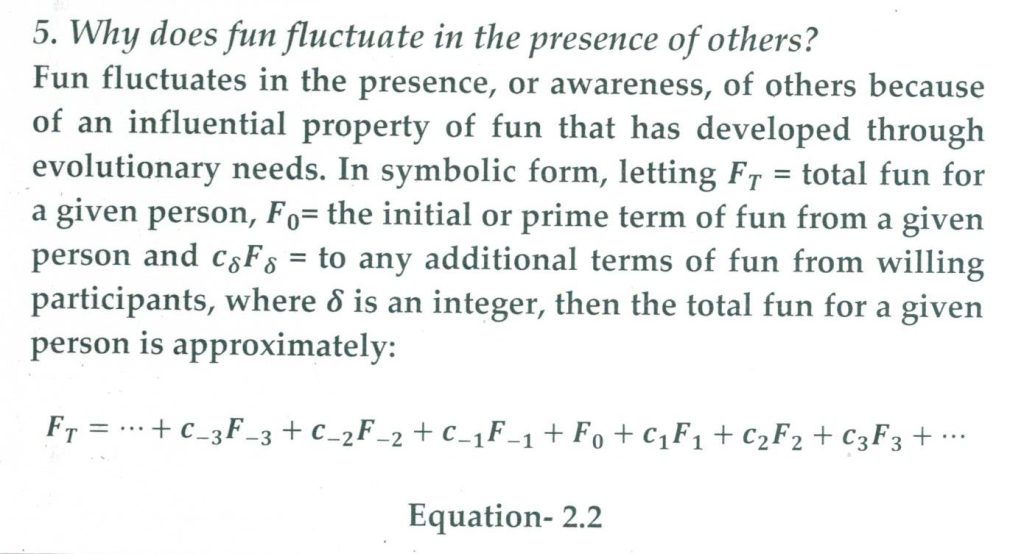
In a similar manner as with motivation, there are four comments that need to be clarified with respect to equation-2.2. First, there will always be at least two sources of infinite sum-directions of fun for any given person. These two sources will automatically be drawn from the biological father and biological mother of a given person. And, from an evolutionary perspective, this influential property of fun—of giving and receiving additional fun terms—serves as a critical source of supplemental fun for early life span development.
There is one warning here also. Equation-2.2 suggests that for maximal life span development, both biological parents are needed within close proximity, especially during early life span development. However, later in life, it may be possible that additional branch summation directions may appear, in addition to the original two branch paths of sums. Furthermore, a reordering of sums from both directions may develop throughout a person’s life span development.
The second comment is with the additional terms to the left and to the right of the initial main source of fun, F sub zero. From the perspective of evolution, it stands to reason that any additional terms will first try to come from immediate family members of biological mother and father; and then any additional fun terms will come from friends, associates and then all else that is alive or within the reality of a given person.
The third comment deals with the “C” values in front of the additional fun terms “F”. These “C” values indicate percentage of influence (magnitude) and quality of influence (ether positive or negative). However, these “C” values are not forced upon any person. There is still a dependence on a person’s free-will to accept any quantity or quality of fun.
The fourth comment that needs to be made is with the ellipsis “…” on both ends of the right hand side of equation-2.2. These symbols indicate that all human beings will be able to contribute to any person’s total fun. Further still, it is possible that after all human beings have been accounted for, then all other living beings may contribute, to a certain extent, to the total fun of any given person.
At this point, I am now able to answer the fifth interconnected question of consciousness, with respect to motivation and fun.
The Sixth Interconnected Question of Consciousness:
What is the connection between motivation and fun?
From the start, the main factor that stands out between motivation and fun is willpower. Notice, in motivation, an increase in willpower has a direct increase in total motivation. However, this is not the case with respect to fun. There is an opposite relationship. That is, when willpower is not stressed, not forced or not mainly required, then fun can increase. Of course, if willpower is fixed and the numerator of fun increases, then fun also increases.
Thus, from an evolutionary perspective, the main connection or purpose of fun, with respect to motivation, is to allow for willpower to recover. Meaning that, when willpower is used throughout the day, there will be a fatigue placed on willpower—and, by extension, on motivation.
Consequently, this may be one of the reasons that every human being will require a certain amount of sleep during a given twenty four hour period of day.
To a greater extent, the quality of fun a person experiences appears to be motivation-exhaust-dependant. Meaning that, deliberate stress of a person’s willpower, (within their motivation), in daily life is required for fun to be realized and focused within happiness, and not within pleasure. In other words, the main purpose of fun is to allow for proper willpower development in life, provided that willpower is stressed enough towards self development and improvement, with respect to positive connections in life.
Of importance to note, there are two extreme cases that must be avoided with respect to fun and motivation.

In this case, the denominator of the equation of fun increases without boundary. That is, willpower increases and increases with no sign of stopping. In this case, this means that a person is participating in an event or events that require massive amounts of sustained or increased levels of motivation.
This is concerning, since with greater and greater use of willpower, a person’s overall fun will approach zero. And, if fun is too close to zero for too great of time, then a person will need drastic recovery of their willpower. Thus, sleep or other activities that allow for willpower to recover will be needed. Otherwise, if the recuperative requirements of willpower are not allowed, or worst ignored for too long, then a person will increase their chances of injury or death in life. Recall, willpower acts like a muscle, which means that willpower has a limit—and a rip or break is inevitable with overuse.

In this case, the denominator of the fun equation is fixed as the numerator increases with no upper limit.
At first glance, this may seem as though a person will experience greater and greater levels of pure ecstasy. And, for a certain time interval, this may well be the case. However, there is a severe warning that must be taken into account as a person experiences gargantuan levels of fun.
Notice, as the numerator increases, and overall fun increases too, the willpower requirements to participate in life become less and less needed. So, even though it was stated that willpower would be fixed in this case—willpower can’t stay fixed. Instead, in this case, willpower requirements will decrease, and eventually weaken. Furthermore, if fun is sustained at too high a value, for too long of a time period, then the minimum willpower requirements to effectively function in life may be drastically increased.
As a consequence, once a person’s willpower is weakened and damaged beyond certain limits, then there is an increased chance that a person will self annihilate from life and/or ignore the general purpose of life—once the high source of fun is removed. Therefore, proper boundaries and limits and moderations on fun are required for maximal life span development.
At this point, I am now able to answer the sixth interconnected question of consciousness, with respect to motivation and fun.
6. What is the connection between motivation and fun?
The purpose of fun is to allow for the factor of willpower, within motivation, to: rest, recover and adapt. In greater detail, the quality and quantity of fun is dependent on the quality and quantity of willpower training practiced, first, within motivation.
The Seventh Interconnected Question of Consciousness:
What is the rule of misery?
There is a most critical warning that must be monitored when a person socializes with others, or contemplates life. And, it is centered on the property of influence, which exists within every person’s motivation and fun, to increase or decrease their values of total motivation and total fun.
Unfortunate, not all persons (or personal attitudes) have a positive or good influence on life. In particular, many individuals take great pleasure from increasing chaos and pain in others. And, as there weapon of choice, these individuals manipulate, instigate and orchestrate thoughts and actions in the life of others to create misery.
However, there are clues that a person may observe to identify when a person may be focused on creating misery.
First, there is anger and hatred. Nurturing angry thoughts, words and actions breeds the seeds of misery.
Second, there is contempt. Living life through the perspective of contempt grows the roots of misery.
Third, there is blame. Creating blame and using blame as a viable component of life, spreads the fruit of misery.
A final word of caution: individuals that find pleasure in spreading misery tend to be excellent actors. Therefore, eternal vigilance is required in life. For those focused on spreading misery tend to be deceptive in social settings, and overall they tend to practice being secretive, manipulative and self-centered at the cost of other’s well being.
As a defense, it is of great importance that self development, strengthening individual core values and practicing daily willpower training are always part of any goal or interaction of life, in general.
At this point, I am now able to answer the seventh interconnected question of consciousness, with respect to motivation and fun.
7. What is the rule of misery?
Misery loves company; and, misery will always try to instigate, manipulate and create chaos, pain and mayhem in the lives of others, if left unchecked.
Thank You
Thank you for your attention, Dear Reader. I am grateful for your time and consideration of my ideas. Next week, I will post the first part of Chapter-3: Reality and Evolution.
 Total Consciousness