Chapter-2: Motivation and Fun
Outline of Article:
- The Fourth Interconnected Question of Consciousness
- Thank you
The Fourth Interconnected Question of Consciousness:
What are the factors of fun?
One of the main reasons that motivation and fun are often confused for one another is because of the factors they share. Granted, there are numerous ways to define fun; but I have narrowed down the overall definition of fun to a general small set of factors. Specifically, the main factors of fun are value, expectation, willpower and joy.
As can be seen, three of the main factors of fun are the exact same factors that are found within motivation. But there is a crucial difference. The way in which the factors are used, within fun, makes a tremendous impact on life. The result being that motivation and fun are nowhere near equivalent expressions.
Before stating the actual formula for fun, I will need to define four important terms: emotions, joy, happiness and pleasure.
Recall that within this book, consciousness is defined as consisting of at least three types or orders of consciousness. However, in addition to these three types being primarily responsible for distinct labors of awareness and connectedness with reality, they must also exist in a type of partitioned manner, with one another. As such, direct communication does not exist between the three types of consciousnesses. Instead, there are indirect processes that allow for communication to occur between the three types of consciousnesses. One such way is through emotions.
Hold for moment, motivated reader, in chapter-3, I will provide some justification for the partitioned—yet, interconnected—existence of the three types of consciousness. And, why the three types of consciousness must not have direct communication between each other. Until then, for now, I will continue with providing some basic definitions:
Emotions are one form of free-will communication between the three types of consciousness, which are the result of specific chemical releases within the body.
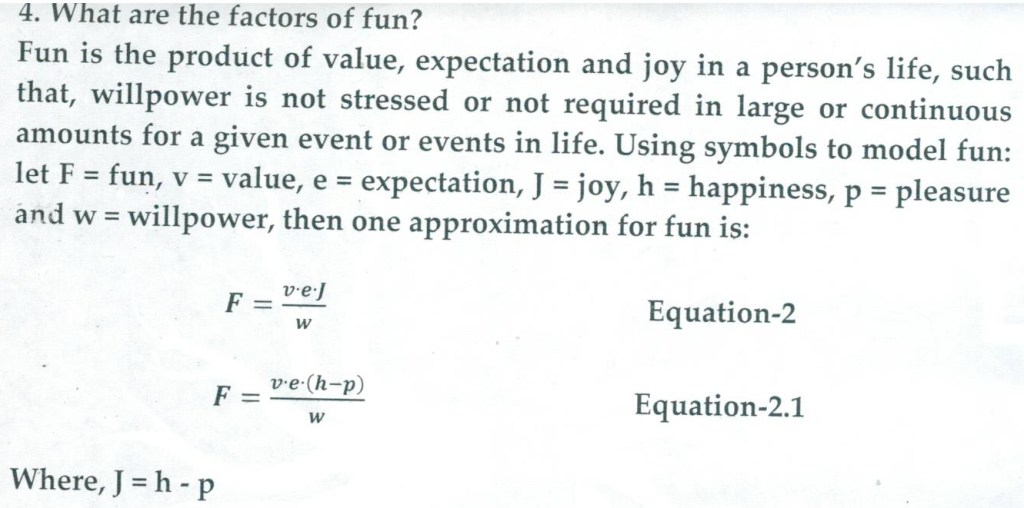
Joy is an ostensibly positive emotion experienced within the body. However, in a more precise manner, joy can be further defined as the difference between happiness and pleasure. In other words, letting J = joy, h = happiness and p = pleasure, then J = h – p. Of course, an immediate question is, why a difference? The answer is based on evolutionary developments. And, once I define what is meant by happiness and pleasure, the reader will see why this difference exists.
Happiness is a positive emotion that results from experiences, actions or thoughts in support of evolutionary positive development. In other words, happiness is based on: responsibilities for self and others; long term connection with others; positive contribution to self, to family and to community; mutual healthy communication with others; accomplishment of positive goals in life, in the pursuit of willpower development; and, not based on artificial influences, such as drugs.
Pleasure is an ostensibly positive emotion that results from experiences, actions and thoughts that are not in support of positive evolutionary development. In other words, pleasure is based on: hedonistic practices; self-centered lifestyle choices; ignoring personal, family and community responsibilities; deception of others for personal gain; manipulation of others for personal desire; and the use of recreational drugs.
Therefore, in general, fun can be defined as the product of value, expectation and joy in a person’s life, such that willpower is not stressed, or not required in large or in continuous amounts, for a given event or events in life. As such, fun is inversely affected by willpower.
At this point, I am now able to provide an approximate solution to the fourth interconnected question of consciousness, with respect to motivation and fun.
Thank You
I appreciate your time in reading my blog post. Next Saturday I will upload the next part of Chapter-2: Motivation and Fun, from my unabridged book on metaphysics, Web of Consciousness: An Interconnected Life.
 Total Consciousness