Chapter-3: Reality and Evolution
Outline of Article:
- Introduction
- The First Mysterious Question of Reality and Evolution
- Thank you
Introduction
One of the biggest mysteries of life is the connection between reality and consciousness. This mystery revolves around explaining the exact nature of reality, and of explaining the exact workings of evolution within reality.
Unlike other curiosities of life, an approximate description of reality and the workings of evolution cannot be so easily reasoned away. Even elite scientists of the world struggle to define reality, and to describe the finer details of evolution—many don’t even try.
Hence, it is with great humility that I submit a very, very rough approximation (most likely incorrect model) of this chapter’s findings, with respect to reality and evolution.
Specifically, the analysis of this chapter will focus on eight mysterious questions of reality and evolution, with respect to consciousness.
First, what is imagination? Second, why does consciousness exist in a partitioned-type manner? Third, what is reality? Fourth, how does evolution work? Fifth, why do good and evil exist? Sixth, what is sin? Seventh, is resistance to evil futile? And eighth, what does it mean to be strong in evolution?
The First Mysterious Question of Reality and Evolution:
What is imagination?
Of course, there are various ways to define imagination; but, for the sake of generality, this chapter will only focus on the main characteristics of imagination. Mainly, there are two primary terms which can be increased, or expanded upon, to account for the degree of imagination in any person, namely: knowledge and creativity.
In order to motivate the final statement that describes imagination, let I = the amount of imagination within a person, let N = the set of knowledge within a person and let C = the set of creativity within a person. Furthermore, we can reasonably assume that knowledge and creativity must each be strictly greater than zero. Then, as a rough approximation, we have that I = N + C.
However, this model, I = N + C, represents only a static initial level representation of imagination. In living reality, a person can always increase their imagination by considering more than one aspect of their knowledge at a time.
For instance, a person could pair one aspect of their knowledge with another aspect of their knowledge, even if they are the same aspect of knowledge, which can be expressed as, (N)(N), a type of knowledge product.
In a similar manner, a person could increase their imagination by following the same process with creativity and arrive at, (C)(C).
And, of course, a person could increase their imagination by pairing one aspect of their knowledge with one aspect of their creativity (and vice versa) and arrive at (N)(C) or at (C)(N).
Since we are only concerned with a rough approximation of imagination, then we will assume that (N)(C) and (C)(N) are equivalent from a mathematical value perspective; even though from a reality perspective these two products need not be commutative.
Therefore, we can state another approximation for imagination, which accounts for these product increases:

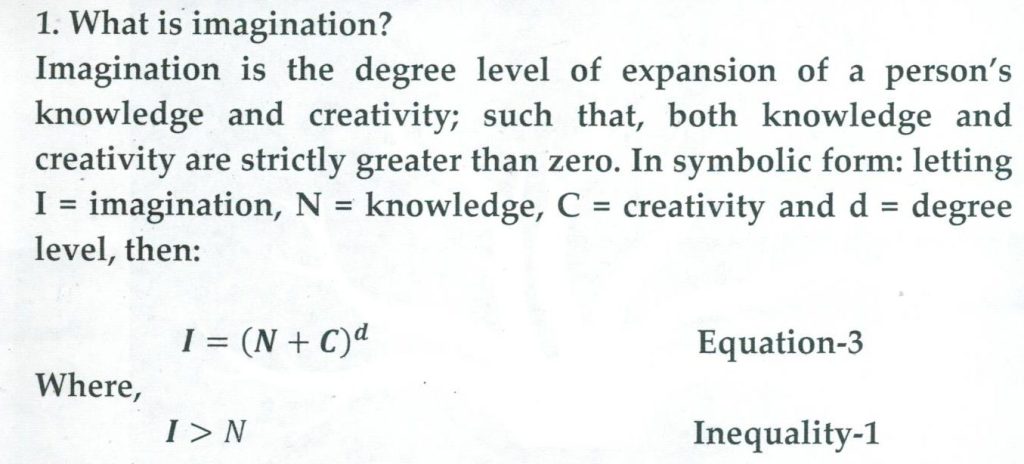
However, the degree to which we could match up knowledge and creativity does not need to be limited to pairs. We could have triples, quadruples or more d-products with respect to knowledge; and the same could be said about creativity. This suggests that a better approximation that accounts for this level of degree, d, of imagination in a person is:

As an immediate consequence of equation-3, we see that imagination must be strictly greater than knowledge. For clarity on this idea, consider the requirements needed to form new knowledge. That is, there must be some new aspect in a person’s awareness before new knowledge can exist. Hence, new knowledge is directly dependent on some non-zero quantity of creation or creativity by the individual person. Consequently, this implies that any non-zero quantity of knowledge can only exist after a certain amount of creativity exists first. Therefore, if any amount of knowledge does exist, then creativity must be strictly greater than zero. Thus, we have the strict inequality, with respect to imagination and knowledge:

At this point, I am now able to answer the first mysterious question of reality and evolution.
Thank You
I appreciate your time in reading my blog post. Next Saturday I will upload the next part of Chapter-3: Reality and Evolution, from my unabridged book on metaphysics, Web of Consciousness: An Interconnected Life.
 Total Consciousness
Thank you for the comment