Chapter-3: Reality and Evolution
Outline of Article:
- Introduction
- The first mysterious question
- The second mysterious question
- Thank You
Introduction
One of the biggest mysteries of life is the connection between reality and consciousness. In particular, this mystery revolves around explaining the exact nature of reality, and of explaining the exact workings of evolution within reality.
Unlike other curiosities of life, the precise description of reality and the workings of evolution cannot be so easily reasoned away. Even elite scientists of the world struggle to define reality, and to describe the finer details of evolution—many don’t even try.
Hence, it is with great humility, that I submit a very, very rough approximation (most likely incorrect model) of this chapter’s findings, with respect to reality and evolution.
Specifically, the analysis of this chapter will focus on eight mysterious questions of reality and evolution.
First, what is imagination? Second, why does consciousness exist in a partitioned-type manner? Third, what is reality? Fourth, how does evolution work? Fifth, why does good and evil exist? Sixth, what is sin? Seventh, is resistance to evil futile? And, eighth, what does it mean to be strong in evolution?
The First Mysterious Question of Reality and Evolution:
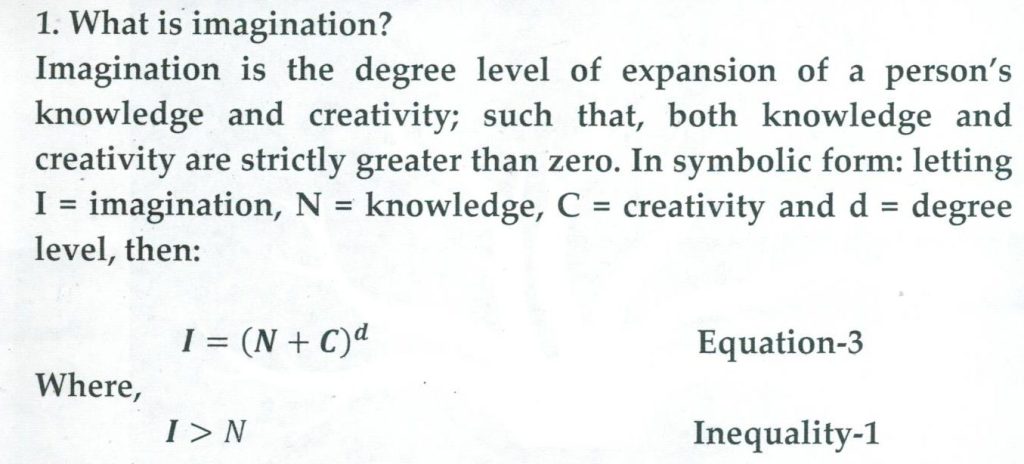
What is imagination?
Of course, there are various ways to define imagination; but, for the sake of specificity, this chapter will only focus on the main characteristics of imagination. In particular, there are two primary terms which can be increased, or expanded upon, to account for the degree of imagination in any person, namely: knowledge and creativity.
In order to motivate the final statement that describes imagination, let I = the amount of imagination within a person, let N = the set of knowledge within a person and let C = the set of creativity within a person. Furthermore, we can reasonably assume that knowledge and creativity must each be strictly greater than zero. Then, as a rough approximation, we have that I = N + C.
However, this model, I = N + C, represents only a static initial level representation of imagination. In reality, a person can always increase their imagination by considering more than one aspect of their knowledge at a time.
For instance, a person could pair one aspect of their knowledge with another aspect of their knowledge, even if they are the same aspect of knowledge, which can be expressed as, (N)(N), a type of knowledge product.
In a similar manner, a person could increase their imagination by following the same process with creativity and arrive at, (C)(C).
And, of course, a person could increase their imagination by pairing one aspect of their knowledge with one aspect of their creativity (and vice versa) and arrive at (N)(C) or at (C)(N).
Since we are only concerned with a rough approximation of imagination, then we will assume that (N)(C) and (C)(N) are equivalent from a mathematical value perspective; even though from a reality perspective these two products need not be commutative.
Therefore, we can state another approximation for imagination, which accounts for these product increases:

However, the degree to which we could match up knowledge and creativity does not need to be limited to pairs. In actuality, we could have triples, quadruples or more d-products with respect to knowledge; and the same could be said about creativity. This suggests that a better approximation that accounts for this level of degree, d, of imagination in a person is:

As an immediate consequence of equation-3, we see that imagination must be strictly greater than knowledge. For clarity on this idea, consider the requirements needed to form new knowledge. That is, there must be some new aspect in a person’s awareness in reality before new knowledge can exist. Hence, new knowledge is directly dependent on some non-zero quantity of creation or creativity by the individual person. Consequently, this implies that any non-zero quantity of knowledge can only exist after a certain amount of creativity exists first. Therefore, if any amount of knowledge does exist, then creativity must be strictly greater than zero. Thus, we have the strict inequality, with respect to imagination and knowledge:

At this point, I am now able to answer the first mysterious question of reality and evolution.
The Second Mysterious Question of Reality and Evolution:
Why does consciousness exist in a partitioned-type manner?
Suppose, for the sake of reasoning, that consciousness did not exist in a type of partitioned manner within a living being. Then, all processes of life and experiences with life, past and current, would be within a present state of awareness at all times. Moreover, this perpetual awareness would be present during every instant of choice and of action in reality. Meaning, everything that has ever occurred within a person’s life would be immediately available at every instant in life, for consideration, within a person’s free-will of choice.
As a consequence, basic life needs, exploring any environment and even reproduction in the world, would require tremendous amounts of time for analysis. This is because, at each moment of thought and action in the world, there would be a requirement of an almost infinite amount of detailed awareness, to review all past events, in order to make a trial decision in the present. And, this pattern would be repeated at every micro-instant of time moving forward in the present.
However, this single state of awareness creates a debilitating- counterproductive trait that would grind evolution to a halt. In other words, such a state of being aware and connected to reality, across all previous times, would drastically increase response times in a compounding effect, in present reality and in future reality.
But, this poses a huge problem in the case of real world interactions. Since, there is often very little opportunity to contemplate—and to assess everything about the past—before making a trial decision in the present. Thus, from an evolutionary perspective, consciousness must exist in a type of partitioned manner to allow for effective responses in reality, and to minimize trauma effects in choices and to create effective systems for exploration and for reproduction in present reality.
To further clarify this point, of consciousness existing in a type of partitioned manner, consider how people make decisions. Often people comment by saying: “It makes sense to me”, or, “It seems like a good plan”, or, “My gut instinct,” or “My intuition” or that “I had a bad or good feeling” when making a decision in life. In all these cases, these feelings for or against something are communications from their ava-consciousness and i-consciousness, with their e-consciousness. Furthermore, to talk about instinct or reflexes of a person, is to acknowledge that consciousness exists in a partitioned type manner.
At this point, I am now able to answer the second mysterious question of reality and evolution. However, dear reader, there is another main reason for why consciousness exists in a partitioned manner; but, this additional perspective will be explained later in this chapter.
2. Why does consciousness exist in a partitioned-type manner?
Consciousness exists in a partitioned-type manner because of the need to adequately adapt, to evolve, to reproduce and to properly interact with reality, within the constraints of present time.
Thank You
Thank you for your attention, Dear Reader. I am grateful for your time and consideration of my ideas. Next Monday, I will post the second part of Chapter-3: Reality and Evolution.

